House Suggests a Simple Test to Try and Help a Man Live a Normal Life Again
A rape kit is a packet of items used by medical personnel for gathering and preserving physical evidence following an allegation of sexual assail. The evidence collected from the victim tin aid the criminal rape investigation and the prosecution of a suspected attacker.[1] [ii] [3] [iv] Deoxyribonucleic acid evidence can accept tremendous utility for sexual assault investigations and prosecution by identifying offenders, revealing serial offenders through Dna matches beyond cases, and exonerating those who have been wrongly accused.[five]
The kit was adult in Chicago in the mid 1970s, in order to provide a more uniform protocol for prove collection after sexual assaults. While Louis R. Vitullo is frequently credited as the developer of the first kit, it was originally researched and proposed to Vitullo by Martha 'Marty' Goddard, who was a victim advocate and founder of Chicago's Citizens for Victims Assistance system, and herself a sexual assault survivor.[half-dozen] [7] [viii] [ix] For years, the standardized tool was referred to as a Vitullo kit.[ane] [10] Today it is colloquially referred to as a rape test kit or a rape kit, which is used interchangeably to refer to the specific evidence that is obtained through the use of the rape kit.[11] Other terms and abbreviations used are sexual assail kit (SAK), a sexual attack forensic evidence kit (SAFE), sexual assault evidence collection kit (SAECK), sexual offense evidence drove kit (SOEC) and physical evidence recovery kit (PERK).[12]
Invention of the kit [edit]
In the 1970s, subsequently the women'south motility had gained its showtime traction, and the media began to embrace the reporting of rape and other forms of sexual assail, a sexual assault survivor named Martha Goddard embarked upon a crusade to create a comprehensive rape show collection kit and lobby for its adoption by law enforcement agencies. The lack of standardized protocol for correctly collecting such evidence, and the lack of understanding of or sympathy for those suffering the psychological trauma of such crimes meant that such show, when it was nerveless, was not preserved in a way that maintained its integrity. Goddard founded the Chicago-based Citizens Committee for Victim Help to address the issue, researching the process by consulting with medical professionals, law enforcement officials, members of the justice organisation, and scholars.[6] Through her friendship with baron Christie Hefner, Goddard caused funding for the kits from Playboy Foundation, the charity founded past Hefner's begetter, Playboy founder Hugh Hefner.[vii] [10]
The kit was get-go utilized in September 1978, according to a 1980 Chicago Tribune article, when 26 Cook Canton hospital emergency rooms incorporated its apply into their standard practise for gathering trace prove when treating rape victims. It consisted of a paper-thin box containing items including swabs, slides and a minor comb, and instructions for using them. Less than ii years subsequently, 215 hospitals beyond Illinois were using information technology.[10]
The kit became known as "Vitullo kit" after Chicago police sergeant Louis Vitullo, the Chicago crime lab's chief microanalyst who worked on loftier-profile cases. This designation came about at Vitullo's insistence because, co-ordinate to Vitullo'south colleague, Marian Caporusso, forensic experts had "the final say-so for a lot of the design features." Equally a consequence, the press described the try to create and implement the kits equally a collaboration between Vitullo and Goddard.[10]
Based upon the effective use of the kits in Chicago, New York City adopted Goddard's kit system in 1982. In 1984, Goddard gave a presentation virtually the Chicago pilot projection at an FBI conference. Based on her presentation, The Department of Justice provided Goddard with funding to travel to help other states begin their own rape kit pilot programs.[7]
In a 2003 interview, Goddard related that through her work in a Chicago teen crunch center, she learned virtually the very low charge per unit at which rapes resulted in prosecutions.[9]
Clarification and use [edit]
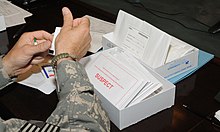
Medical professionals acquire how to use a rape kit at Army camp Phoenix near Kabul, Afghanistan.
Kit contents [edit]
A rape kit consists of minor boxes, microscope slides and plastic numberless for collecting and storing evidence such every bit clothing fibers, hairs, saliva, blood, semen or body fluid.
Rape kits vary by location, but usually include the following items:[ane] [12] [13] [xiv]
- Instructions
- Bags and sheets for evidence collection
- Swabs for collecting fluids from the lips, cheeks, thighs, vagina, anus, and buttocks
- Sterile urine collection containers
- Sterile sample containers
- Blood collection devices
- Comb used to collect hair and fiber from the victim's trunk
- Clear glass slides
- Cocky-sealing envelopes for preserving the victim'south dress, head hair, pubic hair, and claret samples
- Nail selection for scraping debris from beneath the nails
- White sheets to catch physical evidence stripped from the body
- Documentation forms
- Labels
- Sterile water and saline[1] [12] [xiii]
Examiners [edit]
Rape kit examinations are performed past medical professionals, most commonly physicians and nurses.[15] In some locations, examiners accept received special grooming on performing sexual assault forensic exams. For example, many hospitals and wellness facilities in the United States and Canada have sexual set on nurse examiners (SANEs) who are trained to collect and preserve forensic evidence and to offer emotional support to the victim.[xvi] [17] According to the International Association of Forensic Nurses, the number of SANE programs has steadily increased throughout the globe since its introduction in the The states in the 1970s.[18] Equally of 2016, over 700 SANE programs exist in the U.s.a., Canada, and Australia.[xviii] SANEs were introduced in the United Kingdom in 2001.[xix] Japan has had a limited number of SANEs since as early on every bit 2007.[twenty]
Prove collection [edit]
The process of collecting a rape kit is highly invasive and extremely time-consuming.[21] The physical exam begins with the victim disrobing while continuing on a large sheet of butcher paper, which collects whatever trace evidence that may fall from the victim's trunk or clothes. The victim'southward clothing is carefully examined for trace show earlier each garment is individually packaged with sheets of paper between folds to protect against cross-contagion.[22]
Examiners so collect biological samples of semen, blood, saliva and other bodily fluids by swabbing the victim's genitals, rectum, oral fissure and body surfaces.[xvi] Examiners also collect fingernail scrapings and pluck head and pubic hairs. If the facility has the means, and the victim consents, the examiner will as well take photographs of genital injuries using a colposcope.[23]
In addition to facilitating the drove of biological samples and injuries, the kit guides the documentation of the victim's medical history, emotional state, and business relationship of the assail.[24] The entire process of collecting the rape kit takes between 2.5 and 5 hours to complete.[21] [24] [25] [26] While the test is going on, the victim has the right at whatever point to ask questions or stop the examination completely.[12]
Testing [edit]
Upon completion, the rape kit is sealed and typically transferred to local law enforcement. In the United States, if the victim is undecided most reporting the rape, the kit may instead be stored at the examination facility or at a law enforcement facility equally an "bearding" kit.[27]
The law enforcement agency conducting the rape investigation can ship the rape kit, in whole or in part, to the forensic science criminal offense lab for assay. Forensic scientists will endeavor to develop a DNA profile of the aggressor using the samples collected in the rape kit. If successful, the crime lab will search the DNA profile confronting Dna profiles of convicted offenders and other offense scenes using a DNA database. For example, crime labs in the United States run DNA profiles through the three-tiered Combined Deoxyribonucleic acid Alphabetize System (CODIS), which was developed in 1990 and contains Deoxyribonucleic acid profiles at the national, state, and local level.[28] Similarly, the need to solve sexual assault crimes in Brazil led the Forensic DNA Research Institute of Federal District Ceremonious Police to create a Deoxyribonucleic acid database in 1998 containing testify specifically collected in sexual assault cases.[29] DNA matches in such databases not merely aid in identifying the aggressor where unknown to the victim, but also may aid determine whether the assailant (known or unknown to the victim) is a serial rapist. These findings eventually may be fabricated bachelor for utilize in court.[28]
In some cases, the rape kit does non yield Dna show and the forensic scientist is unable to develop a DNA profile of the assailant. This may be because the assailant did non leave Deoxyribonucleic acid behind, or too much time passed before the victim had a rape kit exam performed, or the rape kit evidence may accept been improperly collected, stored or handled.[30] Due to the backlog of sexual assault cases, forensic scientists have been challenged with the task of determining how to process the sexual assault kits effectively and within the statute of limitation on assaults.[31]
Damaged evidence is something that is common among rape kits because survivors of sexual assault typically desire to wash themselves every bit presently every bit possible following an set on. Prior to the test, information technology is desired that patients avoid using the rest room, combing their hair, bathing, changing their clothes or cleaning up the scene of the set on. Virtually prove needs to be nerveless within 72 hours to be feasible, and patients are brash to either bring or wear the clothing they had on when attacked to the exam.[12]
Influence on sexual assault cases [edit]
Rape kit evidence tin can aid the criminal rape investigation and the prosecution of a suspected assaulter.[1] It may as well be used to exonerate the wrongly accused.[32] The benefit of rape kit testify depends in part on the character of the attack.[ citation needed ]
Stranger cases [edit]
In stranger sexual assault cases, the assaulter is unknown to the victim. In such cases, rape kits may exist instrumental in identifying the assailant through Deoxyribonucleic acid profiling, which research suggests may help lead to an arrest. For example, a 2009 study examining sexual assail cases from 2 of 389 criminal offense laboratories in the U.s. establish that stranger-rape cases with forensic evidence were 24 times more than likely to produce an arrest than stranger-rape cases without forensic evidence.[33]
Stranger cases tin can take a longer time to identify the perpetrator considering without forensic evidence, the case becomes significantly more than difficult to prosecute. This is one of the chief issues that many victims face when coming forward that they had been raped.[34]
Acquaintance rape [edit]
The vast bulk of sexual assaults are non-stranger (or "acquaintance") cases where the victim knows the attacker.[33] : 331 [35] : 256 While identifying a suspect is not at result, the kit's forensic evidence can be used to confirm offender identity in acquaintance rape cases. The kits may too be used to make up one's mind whether the offender committed other crimes.[32]
In many acquaintance sexual set on cases, the accused assailant will defend the accusations equally consensual encounters.[33] : 331 In such cases, rape kit evidence that documents the victim's injuries, e.g., photographs of bruising, is a useful tool to corroborate allegations of non-consensual sexual contact. In cases where the victim suffers a serious injury, filing charges and reaching convictions is more likely.[36]
In other acquaintance cases, the assailant may deny that sexual intercourse occurred at all. In such cases, specimens that show either sperm or specific enzymes that are unique to seminal fluid (enzymes prostatic acid phosphates or acid phosphatase) can be used to bear witness sexual contact.[16]
Serial rape cases [edit]
Serial rape is defined as an assailant that has raped two or more victims.[37] Serial rape may involve sexual partner violence or non-partner sexual violence, and it may be in the aforementioned family, in the same or different regions of a city, or in different cities or states.[29] DNA collected past rape kits can help lead to identifying and absorbing a person guilty of serial rape.[4]
In both stranger and non-stranger sexual assault cases, DNA testing of rape kit evidence and Dna database hits assist identify serial sexual assaults. For example, a 2016 report of 900 previously untested rape kits in Detroit, Michigan constitute 259 CODIS hits, which included stranger and non-stranger sexual assault Dna profiles. Sixty-nine of the hits were series sexual assault hits, xv of which were acquaintance (non-stranger) sexual assault cases.[32]
In a written report analyzing the status of Brazil'south DNA database in 2015, researchers found 223 matches related to 78 serial rapists.[29] At the fourth dimension, the Dna database contained 650 profiles from one type of analysis of samples nerveless in rape kits—male autosomal STR profiles—and 420 profiles from a second blazon of analysis—complete 23Y-STR profiles.[29]
Barriers to utilize [edit]
Backlog [edit]
Rape kit backlog refers to the problem of untested sexual assault kits.[23] The problem is twofold: it involves both the upshot of rape kits not being submitted to crime labs for testing and the related event of crime labs non having enough resource to test all of the submitted kits.[32] [38]
I cause of the backlog of rape kits being tested is detectives and/or prosecutors failing to request a DNA analysis. When someone fails to request a DNA assay, the kit sits in a police force evidence storage facility untested. A rape kit is considered backlogged when information technology is not submitted for analysis within ten days of the evidence being submitted. A 2d crusade of the backlog is offense laboratory facilities receiving the rape kits and not testing them in a timely fashion. The Joyful Heart Foundation, an anti-sexual violence clemency founded by actress and activist Mariska Hargitay, considers these kits backlogged when the kit is not analyzed within 30 days of it being sent to the lab.[4]
Conservative estimates bespeak at that place are 200,000–400,000 untested rape kits in U.S. police departments, and large stockpiles of kits have been documented in over five dozen jurisdictions, sometimes totaling more than 10,000 untested rape kits in a unmarried city.[5] The federal Deoxyribonucleic acid Initiative has helped state every bit well every bit local governments to increase the ability of their DNA laboratories and decrease backlogs.[39] The bodily number of untested rape kits is currently undefined because there is no nationwide organisation set up up to go along rails of the cases. [40] This tin be attributed to the lack of a mutual definition of backlog, which can relate to cases non worked within a month of submission, or cases that have non been submitted to the forensic labs for analysis.[41]
Destruction [edit]
In some locations, rape kits are destroyed before ever being tested and sometimes without notifying the victim. For victims of sexual assault in the United States, for example, the length of time for which a kit can go untested may be shorter than the statute of limitations. Policies in some jurisdictions instruct that rape kits exist destroyed every bit early as six months after they are initially stored.[42] Past contrast, the shortest statute of limitations in the US is three years, though many states do not accept a statute of limitations for rape.[43] Some states, including Washington and Idaho, have legislation in identify that requires a tracking system allowing law enforcement, medical facilities, and survivors to check the condition of kits throughout the unabridged process, from drove to analysis and last disposition, and for survivors to be notified if a decision is made not to test a kit or to its devastation.[44] [45] That is ii and a one-half years prior to the expiration of the shortest statute of limitations on rape found in the United States.[43]
Inaccessibility [edit]
Victims' access to rape kits is frequently limited. In many locations, the non-availability of rape kits prevents victims from obtaining medico-legal testify that would otherwise aid in the criminal investigation and prosecution of their aggressor. In Nigeria, for example, a report analyzing sexual assault in Ile-Ife establish that the majority of victims went to the infirmary within 24 hours of a sexual assault, but did not receive a forensic medical examination because rape kits have withal to be introduced in the country.[35]
In locations where rape kits are bachelor, a lack of trained examiners may still impede the ability of victims to undergo timely sexual set on examinations.[46] Shortages forcefulness victims to expect hours for an exam or to travel long distances in society to accept a rape kit performed within the recommended 72 60 minutes timeframe.[47] [48] These furnishings have been seen in Canada and rural America, where the shortage of examiners has recently been identified.[47] [48] [49]
Insufficiently trained examiners may also pb to deficiencies in rape kits. A report of rape kit drove in South Africa found that rape kits were sometimes inappropriately used, missing proper specimens, or missing necessary forms.[50] The written report recommended improved preparation of wellness care workers to overcome these deficiencies.[50]
Price [edit]
The toll of rape kits is a barrier to utilise in many locations where the victim is billed for the collection of forensic show. Collecting a rape kit reportedly costs upwards of $1000.[51] In some countries, reimbursement for the cost is contingent on the victim reporting the crime to police. In Nippon, for instance, a sexual assault victim must pay for the rape kit upfront, simply constabulary will reimburse medical fees if the victim reports the assault.[52]
Victims of sexual assail in the United states faced similar hurdles until the 2005 reauthorization of Violence Against Women Act (VAWA), which requires states to pay for the price of the rape kit regardless of the victim's decision to report the set on to the constabulary.[53] Nether the more contempo 2013 VAWA reauthorization, which took upshot in March 2015, victims also cannot be required to pay the upfront cost of the exam. States may still require victims to submit claims for the rape kit exams to their personal insurance providers, as long as they are not billed for a deductible or a copay.[54] In the U.s.a., several organizations take pledged millions of dollars in grants to assistance fund the analysis of rape kits in forensic laboratories. [55]
By state [edit]
Republic of ireland [edit]
In the Democracy of Ireland, victims of rape and sexual assault receive a forensic exam in a Sexual Assault Treatment Unit of measurement (SATU).[56] Bear witness is sent to Forensics Science Ireland (FSI), based in the Phoenix Park. At the end of 2018, in that location was a backlog of 70 cases, and it was taking up to a twelvemonth for results to be released.[57]
The states [edit]
In the United States, rape kit costs, availability, proper implementation of the invasive exam, and backlogs have historically presented issues for victims of rape seeking justice.[58] [59] [60]
Equally of May 2009 the federal Violence Confronting Women Act of 2005 went into effect,[13] requiring state governments who wish to continue receiving federal funding to pay for "Jane Doe rape kits" or "anonymous rape tests". These tests allow victims too traumatized to become to the police to undergo the procedure at hospitals. The hospitals maintain the nerveless evidence in a sealed envelope identified just by a number, unless police admission its contents upon the victim'south decision to press charges. While the practise had been recommended by the Federal Bureau of Investigation since at least 1999, and was already followed at some health clinics, colleges and hospitals, and in the state of Massachusetts, many jurisdictions up until and then refused to pay the estimated $800 cost of the rape examination without a law study filed by the victim.[61]
In 2011, the National Plant of Justice published a report, The Road Ahead: Unanalyzed Evidence in Sexual Attack Cases, providing an overview of deep problems nationwide and the contributing factors to ongoing bureaucratic difficulties. These backlogs and delays may pb to a lack of justice for victims, the report notes, and "in worst-case scenarios...lead to additional victimization by serial offenders or the incarceration of people wrongly bedevilled of a law-breaking". Findings include:[62]
- Equally an indicator of how widespread this problem has become, "18 pct of unsolved declared sexual assaults that occurred from 2002 to 2007 contained forensic evidence that was yet in police custody (not submitted to a criminal offense lab for assay)"
- One major challenge is that 43% of police enforcement agencies "do not accept a computerized system for tracking forensic testify, either in their inventory or after it is sent to the law-breaking lab"
- On average, 50–60% of kits test positive for biological material that does not belong to the victim
- Survey responses indicated that in that location may be some misunderstanding of the value of biological prove. Xl-4 percentage of the law enforcement agencies said that one of the reasons they did not send evidence to the lab was that a doubtable had not been identified. Fifteen per centum said that they did not submit evidence because "analysis had not been requested by a prosecutor".[62]
The federal government established the Combined Deoxyribonucleic acid Index System (CODIS) to share Dna matches amidst federal, land and local jurisdictions. The federal Dna Analysis Backlog Elimination Act of 2000 and Debbie Smith Human activity authorizations in 2004 and 2008 provide additional funding to state and local jurisdictions to help clear their rape kit testing backlogs. As of 2014, the federal government estimates a nationwide backlog of 400,000 rape kits, including many from the 1990s when evidence was collected but not tested for Deoxyribonucleic acid due to high costs and more than primitive techniques available at the time.[63]
By state [edit]
California [edit]
According to a 2009 report by Homo Rights Sentry, Los Angeles, California has the largest known rape kit backlog in the United States, with at least 12,669 languishing in storage facilities of the Los Angeles Police Section, Los Angeles County Sheriff's Section, and 47 contained police departments in Los Angeles County, and "smaller, but not inconsiderable" backlogs residing at constabulary crime labs. These backlogs consist of both kits stored in show storage facilities, for which Deoxyribonucleic acid analysis is not requested past investigating detectives, and those submitted for testing at crime lab facilities, but which have non been tested in a timely fashion. Although authorities have struggled to address the backlog problem, their attempts have reportedly been hampered by funding bug and politics. As a consequence of these backlogs, assault survivors are often not informed of the condition of their rape kit or their example.[lx]
Illinois [edit]
Beyond Illinois, where law enforcement and prosecutors handle sex crimes differently, a law excess of nearly 8,000 rape kits accumulated between 1995 and 2009, simply 20% of which were tested. Effective September i, 2010, The Illinois Senate's Sexual Assault Submissions Human action (Senate Bill 3269) requires law enforcement agencies to submit all bear witness nerveless by rape kits for laboratory assay within 180 days afterwards the effective date of October 15, 2010, with a written notice to the State Police. Illinois was the first state to adopt such a law, setting a precedent for other states to follow. Equally of January i, 2011, the Illinois House of Representatives Bill 5976 addresses victims' confidentiality rights and the timely processing of rape kit evidence. Both bills passed the Illinois Full general Assembly unanimously, and were signed past Governor Pat Quinn.[58] [64] [65] [66] [67]
New York [edit]
In New York State, a rape kit is besides known as Sexual Crime Evidence Collection (SOEC) kit.[68] As of 1999, New York Urban center in item harbored nearly 17,000 untested rape kits, which were somewhen eliminated with outside labs. In 2007, the metropolis opened a $290 meg forensic biological science lab. In 2015, the New York County District Attorney's Office announced that they would exist application $38 million in grants to jurisdictions beyond the country in lodge to examination backlogged rape kits.[69]
Texas [edit]
In Texas, information technology is considered unnecessary to administer a rape kit subsequently 72 hours following the attack, equally it is considered unlikely for useful evidence to exist collected, though other types of evidence may still be documented during the medical examination, such every bit survivor statements, and visible injuries such equally bruises, lacerations or seize with teeth marks, through visual inspection, photographs and transcription.[70]
Washington, D.C. [edit]
In Washington, D.C., prior to the Violence Against Women Act, which went into effect in 2009, rape kits, despite being standard issue in hospitals, have historically been difficult to obtain, according to an April 2009 written report by Washington City Newspaper. According to the report, rape survivors historically waited up to 12 hours in D.C. emergency rooms while the OB-GYNs present would attend to more than immediate emergencies, such every bit births, after which the invasive exam would be performed by inexperienced residents, who made poor witnesses at trial. The Sexual Set on Nurse Examiner (SANE) program was established in 2000 at Howard University Hospital in social club to address this concerns, after a decade of attempts by Denise Snyder, executive managing director of the D.C. Rape Crisis Center (DCRCC), to notice a major hospital willing to host the programme, nigh of whom either cited economic concerns or declined to respond to her inquiries. After Howard University adopted the program, survivors encountered the trouble of requiring police authorization earlier receiving a rape examination, which Snyder attributes to a desire to maintain depression criminal offense rates on the part of constabulary enforcement agencies, whom, according to the Washington Paper tend to be unsympathetic to alleged rape victims. Detective Vincent Spriggs, of D.C. Metro P.D.'s Sexual Assault Unit, cites instances of faux or unconvincing rape accusations, and requests for rape kits by women who wish to have pregnancy tests or the morning-subsequently pill administered, as an obstacle to more open up utilize of the kits. In 2008, Howard University canceled the SANE programme, after which it reopened under the supervision of the mayor's office.[13]
Depictions in media [edit]
The problem of rape kit backlogs was employed as a significant plot point in "Conduct", the September 29, 2010 episode of the goggle box criminal offense drama, Law & Lodge: Special Victims Unit of measurement, which depicts the operations of a police sex crimes unit. In the episode, detectives investigate the case of a woman, played by Jennifer Dearest Hewitt, who has been raped multiple times by the same human over the grade of fifteen years. Their investigation leads them to discover that the perpetrator has raped women all over the United states. The detectives try to contact the Special Victims Units in other cities, but to discover that near of them have never tested the majority of their collected rape kits.[71] [72] The episode was based on the existent-life story of advocate and survivor Helena Lazaro.[73]
See too [edit]
- Combined DNA Alphabetize System (CODIS)
- Dna database
- Forensic identification
- Post-attack treatment of sexual assault victims
- Rape in the United States
- Sexual assail
- Sexual Assault Survivors' Rights Act
References [edit]
- ^ a b c d e Pass, Allan D.; Embar-Seddon, Ayn (2009). Forensic Science. Pasadena, Calif.: Salem Printing. pp. 877–880. ISBN9781587654237.
- ^ "Rape". Family Doc. March 21, 2017. Retrieved April 22, 2018.
- ^ "Sexual Abuse and Assault Against Women". WebMD. Retrieved April 22, 2018.
- ^ a b c "What is the Rape Kit Backlog?". Cease the Backlog. Joyful Middle Foundation. Archived from the original on February i, 2018. Retrieved April 24, 2018.
- ^ a b Campbell, R., Fehler-Cabral, G., Bybee, D., & Shaw, J. (2017)."Forgotten evidence: A mixed methods study of why sexual assault kits (SAKs) are not submitted for Dna forensic testing" [ permanent expressionless link ] . Law and Human Behavior, 41 (5), 454-467.
- ^ a b Shelby, Renee (December 24, 2018). "Whose rape kit? Stabilizing the Vitullo® Kit through positivist criminology and protocol feminism". Theoretical Criminology. 24 (4): 669–688. doi:10.1177/1362480618819805. S2CID 149793380.
- ^ a b c Kennedy, Pagan (17 June 2020). "The Rape Kit's Surreptitious History". The New York Times . Retrieved 17 June 2020.
- ^ Freudenheim, Betty (2 December 1978). "Chicago Hospitals Are Using New Kit to Aid Rape Victims Collect Bear witness". The New York Times. p. 48. Retrieved 17 June 2020.
- ^ a b "Marty Goddard Interview Transcript, February 26, 2003". The University of Akron Oral History of the Offense Victim Assistance Field: Video and Audio Archive. The University of Akron. Retrieved 17 June 2020.
- ^ a b c d Ravitz, Jessica (November 21, 2015). "The Story Behind the Beginning Rape Kit". CNN. Retrieved 13 May 2016.
- ^ "Forensic Scientific discipline Central Forensic Science Glossary". Forensic Science Glossary. The Forensics Library. Archived from the original on March thirteen, 2012. Retrieved April 22, 2018.
- ^ a b c d e "What is a Rape Kit?". Rape, Abuse & Incest National Network. 2009. Retrieved Apr 22, 2018.
- ^ a b c d Hess, Amanda (Apr ix, 2010). "Exam Instance: You're Non a Rape Victim Unless Police Say Then" Archived 2010-05-04 at the Wayback Machine. Washington Metropolis Paper. Folio 2 of 3
- ^ "Vaginal swab kit". Pentok. Archived from the original on June xx, 2015.
- ^ Jones, Helen (January 2015). "Rape kit". Salem Press Encyclopedia of Science.
- ^ a b c Ort, Jennifer A. (September 2002). "The Sexual Set on Nurse Examiner". The American Journal of Nursing. 102 (9): 24GG–24LL. doi:10.1097/00000446-200209000-00026. JSTOR 3522934.
- ^ "What Is a Rape Kit?". Rape, Corruption & Incest National Network. RAINN. Retrieved 12 May 2016.
- ^ a b "SANE Plan List". International Clan of Forensic Nurses . Retrieved 14 May 2016.
- ^ Cowley, R.; Walsh, E.; Horrocks, J. (2014). "The role of the Sexual Assault Nurse Examiner in England: nurse experiences and perspectives". Journal of Forensic Nursing. 10 (2): 77–83. doi:ten.1097/JFN.0000000000000026. PMID 24847871. S2CID 36184416.
- ^ Mclean, Ian; Fifty'Heureux, Stephan (2007). "Sexual assault aftercare services in Japan and the UK". Japan Forum. xix (ii): 239–256. doi:10.1080/09555800701422852. S2CID 144123086.
- ^ a b Alter, Charlotte (July 17, 2014). "Hither's What Happens When Yous Go a Rape Kit Exam". Time . Retrieved April 22, 2018.
- ^ Baker, Thomas E.; Roberts, James C. (March 2015). Rape (forensics). Salem Press Encyclopedia.
- ^ a b Campbell, Rebecca; Feeney, Hannah; Fehler-Cabral, Giannina; Shaw, Jessica; Horsford, Sheena (December 23, 2015). "The National Trouble of Untested Sexual Attack Kits (SAKs): Telescopic, Causes, and Future Directions for Inquiry, Policy, and Practice". Trauma, Violence, & Abuse. eighteen (iv): 363–376. doi:10.1177/1524838015622436. PMID 26698602. S2CID 35057287.
- ^ a b Parnis, Deborah; Janice, Du Mont (Dec 2002). "Examining the Standardized Application of Rape Kits: An Exploratory Study of Postal service-Sexual Assault Professional person Practices". Health Care for Women International. 23 (viii): 846–853. doi:10.1080/07399330290112362. PMID 12487699. S2CID 37012778.
- ^ Ledray, L. (1999). "Sexual Assault Nurse Examiner (SANE) Evolution and Operation Guide". Washington DC: Role for Victims of Offense, Part of Justice Programs, U.S. Department of Justice. [ permanent dead link ]
- ^ Hess, Amanda (April 7, 2010). "What's In A Rape Kit?". Washington Metropolis Paper.
- ^ "Sexual Assault Kit Testing: What Victims Need to Know" (PDF). VictimsOfCrime.org. The National Eye for Victims of Crim.
- ^ a b Lenz, Erin J.; Foran, David R. (January 2015). Combined DNA Index System (CODIS). Salem Printing Encyclopedia of Science.
- ^ a b c d Ferreira, Samuel T.G.; Paula, Karla A.; Maia, Flávia A.; Svidizinski, Arthur E.; Amaral, Marinã R.; Diniz, Silmara A.; Siqueira, Maria E.; Moraes, Adriana V. (2015). "The use of DNA database of biological evidence from sexual assaults in criminal investigations: A successful experience in Brasília, Brazil". Forensic Scientific discipline International: Genetics Supplement Series. v: 595–597. doi:10.1016/j.fsigss.2015.09.235.
- ^ "Frequently Asked Questions". Forensics for Survivors. Retrieved April 22, 2018.
- ^ Wang, C., & Wein, L. M. (2018). Analyzing Approaches to the Backlog of Untested Sexual Assault Kits in the U.S.A. Periodical of Forensic Sciences, 63(4), 1110-1121. doi:10.1111/1556-4029.13739
- ^ a b c d Campbell, R.; Feeney, H.; Pierce, S. J.; Sharma, D. B.; Fehler-Cabral, Yard. (March 27, 2016). "Tested at Last: How DNA Evidence in Untested Rape Kits Can Identify Offenders and Serial Sexual Assaults". Journal of Interpersonal Violence. 33 (24): 3792–3814. doi:10.1177/0886260516639585. ISSN 1552-6518. PMID 27021733. S2CID 32860558.
- ^ a b c Sommers, Ira; Baskin, Deborah (2011). "The Influence of Forensic Evidence on the Case Outcomes of Rape Incidents". The Justice System Periodical. 32 (3): 314–334. JSTOR 23268706.
- ^ LeBeau, James (1987). "Patterns of Stranger and Serial Rape Offending: Factors Distinguishing Apprehended and at Large Offenders". Journal of Criminal Law and Criminology. 78 (ii): 309–326. doi:10.2307/1143451. JSTOR 1143451.
- ^ a b Badejoko, Olusegun; Anyabolu, Henry; Badejoko, Bolaji; Ijarotimi, Adebimpe; Kuti, Oluwafemi; Adejuyigbe, Ebunoluwa (2014). "Sexual set on in Ile-Ife, Nigeria". Nigerian Medical Journal. 55 (3): 254–259. doi:10.4103/0300-1652.132065. PMC4089057. PMID 25013260.
- ^ Sommers, Ira; Baskin, Deborah (2011). "The Influence of Forensic Evidence on the Instance Outcomes of Rape Incidents". The Justice Organisation Journal. 32 (three): 314–334. JSTOR 23268706.
The present study likewise confirms prior research that shows a greater likelihood of filing a accuse and reaching a conviction when injuries suffered by the victim are serious (Frazier and Haney, 1996; Spohn, Beichner, and Davis-Frenzel, 2001; Spohn and Holleran, 2001; McGregor et al., 2002; Ingemann-Hansen et al., 2008).
- ^ de Heer, Brooke (Feb 2016). "A Snapshot of Series Rape An Investigation of Criminal Sophistication and Use of Force on Victim Injury and Severity of the Assault". Journal of Interpersonal Violence. 31 (4): 598–619. doi:10.1177/0886260514556110. PMID 25466982. S2CID 145106875.
- ^ "Addressing the Rape Kit Backlog". Rape, Abuse & Incest National Network. RAINN. Retrieved 13 May 2016.
- ^ Nelson, Mark (2010). "Making Sense of Dna Backlogs-- Myths vs. Reality" (PDF). NIJ Journal. Washington, D.C.: National Plant of Justice/U.s.a. Section of Justice; archived at National Heart for Victims of Crime (266). Archived from the original (PDF) on November 23, 2015. Retrieved April 24, 2018.
- ^ Campbell, R., Feeney, H., Fehler-Cabral, G., Shaw, J., & Horsford, South. (2015). The National Problem of Untested Sexual Assault Kits (SAKs): Telescopic, Causes, and Future directions for Research, Policy, and Practice. Trauma, Violence, & Abuse, 18(4), 363-376.doi:10.1177/1524838015622436
- ^ Houck, M. K. (2020). Backlogs are a dynamic organisation, not a warehousing trouble. Forensic Science International: Synergy, 2, 317-324. doi:10.1016/j.fsisyn.2020.x.003
- ^ Kingkade, Tyler (Feb 24, 2016). "Some States Throw Untested Rape Kits In The Trash. These Survivors Want To Change That". Retrieved May 22, 2016.
- ^ a b Smith, Jordan Michael; AJ, Vicens (November 24, 2014). "Map: How Long Does Your State Requite Rape Survivors to Pursue Justice?". Mother Jones . Retrieved May 22, 2016.
- ^ "Drafter'due south Checklist for Rape Kit Reform". Cease the Excess. Joyful Heart Foundation. Archived from the original on February one, 2018. Retrieved April 24, 2018.
- ^ Comprehensive Rape Kit Reform: A Legislative Handbook (PDF). Joyful Heart Foundation. November 2017. Archived from the original on Apr 24, 2018.
- ^ Swan, Sarah (2013). "Triangulating Rape". NYU Review of Law & Social Change. 37: 403–455.
- ^ a b Kane, Laura (October 12, 2015). "Rape kit inaccessibility a hurdle to justice for victims in Canada, say advocates". The Canadian Press. CTV News. Retrieved 13 May 2016.
- ^ a b Paquette, Danielle (April 19, 2016). "Yous accept to bulldoze an hour for a rape kit in rural America". The Washington Mail service . Retrieved May fourteen, 2016.
- ^ United States Government Accountability Office, GAO-16-334 (March 2016). "SEXUAL Assault: Data on Training, Funding, and the Availability of Forensic Examiners" (Report to Congressional Requesters). GAO.gov . Retrieved 14 May 2016.
- ^ a b Jina, Ruxana; Jewkes, Rachel; Christofides, Nicola; Smith, Joe H. (2011). "Recovering of Dna testify afterwards rape". The South African Medical Journal. 101 (10): 758–759. PMID 22272857.
- ^ Caplan-Bricker, Nora (December 22, 2015). "Rape Victims Are Still Being Charged for Rape Kits". Slate . Retrieved May 14, 2016.
- ^ Mclean, Iain; L'Heureux, Stephan (2007). "Sexual attack aftercare services in Japan and the U.k.". Japan Forum. nineteen (2): 239–256. doi:10.1080/09555800701422852. S2CID 144123086.
- ^ Corrigan, Rose (2013). "The New Trial by Ordeal: Rape Kits, Police Practices, and the Unintended Effects of Policy Innovation". Law & Social Inquiry. 38 (iii): 937. doi:10.1111/lsi.12002. S2CID 142975163.
- ^ "Frequently Asked Questions (FAQs) Most Stop Formula Grants" (PDF). United States Section of Justice: Office on Violence Against Women. February 2014. Retrieved May 21, 2016.
- ^ Davis, R. C., & Wells, Westward. (2019). DNA testing in sexual assault cases: When practice the benefits outweigh the costs? Forensic Science International, 299, 44-48. doi:10.1016/j.forsciint.2019.03.031
- ^ "Forensic exam after a rape or sexual assault". www2.hse.ie.
- ^ MacNamee, Garreth. "Delays at forensic lab mean rape victims take to wait longer for cases to progress". TheJournal.ie.
- ^ a b Carmon, Irin. "The Shocking Numbers on Untested Rape Kits"; Jezebel. August 12, 2010, August 12
- ^ "Hargitay's Blithesome Heart". Television receiver Guide. October eighteen, 2010. Folio 4.
- ^ a b "Testing Justice". Human Rights Watch. May 31, 2009
- ^ Wyatt, Kristen (May 13, 2008). "Bearding Rape Tests Are Going Nationwide". ABC News. Associated Printing. Retrieved Jan 28, 2008.
- ^ a b Larsen, Rozanne (August 5, 2011). "The Road Ahead: Unanalyzed Testify in Sexual Assault Cases". Journalist's Resource.
- ^ McEvers, Kelly (Jan 26, 2014). "Tested At Last, Rape Kits Give Evidence To Victims' Stories". All Things Considered. NPR. Retrieved Apr 22, 2018.
- ^ "Crime Summary: Chicago January-August 2010" Archived 2011-07-25 at the Wayback Machine. Chicago Constabulary Department. 2010. Retrieved Apr 22, 2018.
- ^ Hutchinson, Toi West.; McAsey, Emily (2010). "SB 3269 - Sexual Assault Evidence Submission Act". 2010. Illinois Municipal League.
- ^ Ruben, Susan (October 6, 2010). "Rape Kit Backlog Hits Primetime SVU". Ms. Magazine.
- ^ Madigan, Lisa (2010). "Keeping Communities Safe". Illinois Attorney General. Archived Dec xv, 2010, at the Wayback Car
- ^ NYS Sexual Offense And Drug Facilitated Sexual Assault Show Collection Kits/Training Video Archived 2007-12-27 at the Wayback Machine New York State Partitioning of Criminal Justice Services; Accessed Oct thirteen, 2010
- ^ Vance, Cyrus Jr. (September x, 2015). "District Attorney Vance Awards $38 Meg in Grants to Help 32 Jurisdictions in 20 States Examination Backlogged Rape Kits". New York County District Attorney. Retrieved April 22, 2018.
- ^ "Sexual Set on Nurse Examiner (SANE) Program: Frequently Asked Questions". Texas Attorney General. Retrieved April 22, 2018.
- ^ Hargitay, Mariska (October 13, 2010). "Message from Mariska Hargitay: The Shame of Rape-Kit Backlogs" Archived October 21, 2010, at the Wayback Automobile Good Housekeeping.
- ^ Stinchfield, Grant (September 22, 2010). "'SVU' Star Calls for Dallas to Articulate Rape Kit Backlog". NBC.
- ^ "Police and Order: Special Victims Unit of measurement, 'Behave' Viewing Events". Joyful Middle Foundation. Retrieved October 1, 2015.
ortizbescultat1943.blogspot.com
Source: https://en.wikipedia.org/wiki/Rape_kit

Post a Comment for "House Suggests a Simple Test to Try and Help a Man Live a Normal Life Again"